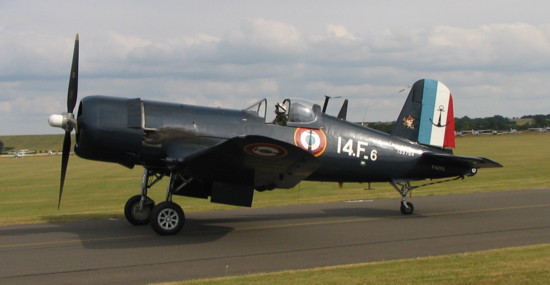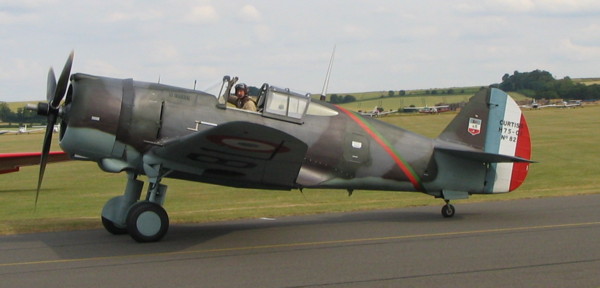
A cheery wave from the pilot of the Curtiss Hawk
75, otherwise known as P-36 (in US service) or Mohawk (to the RAF).
This one has just been restored and is in its first display season,
flying in Armee de l'Air (French air force) colours.
|
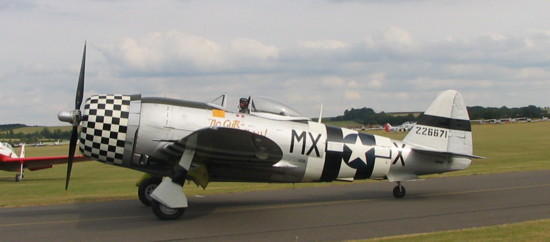
A Republic P-47 Thunderbolt, showing why it had
the nickname of `flying barrel'. Actually its rotundity was dictated
by the gigantic 2,800hp engine which heaved it through the sky at up
to 430mph!
|
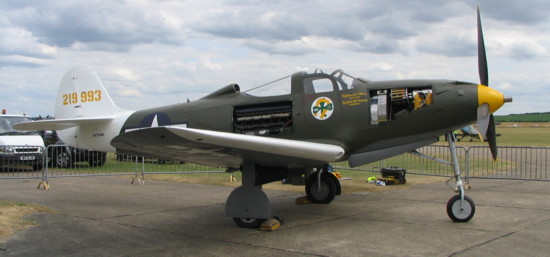
This Bell P-59 Airacobra has been under
restoration for several years, and is almost complete. It is a very
unusual design in having its Allison engine mounted centrally to
optimise weight distribution. It was also one of the first designs
to have a tricycle (nosewheel) undercarriage. Of course, Charles was
very quick to spot the guns ....
|
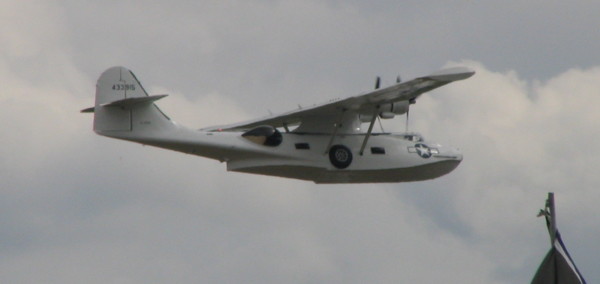
This is the Consolidated PBY Catalina which
Charles and David had been in an hour or so before. It flew together
with another, Dutch, example. It must have looked amazingly modern
when it first flew in 1935.
|
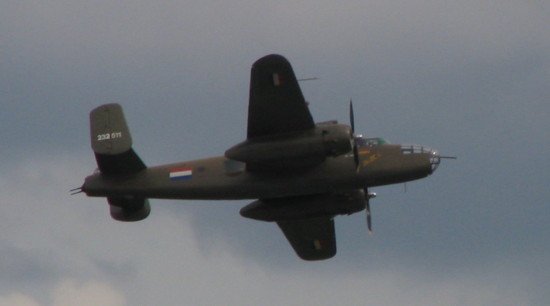
This North American B-25 Mitchell light bomber
participated in the flying display.
|
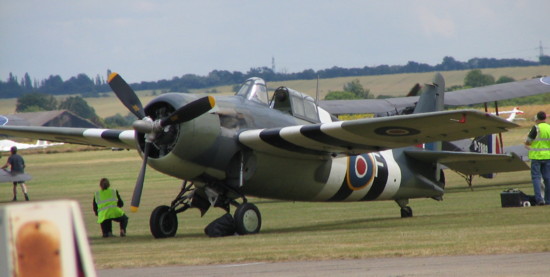
The Grumman F4F Wildcat was the standard US Navy
single-seat fighter at the outbreak of the war. It served very well,
especially in the Pacific. This one is painted as a Royal Navy
Martlet. |
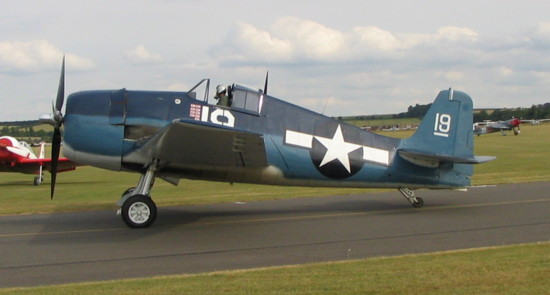
The Grumman F6F Hellcat was the successor of the
Wildcat as one of the standard US Navy carrier-borne fighters in the
second world war.
|
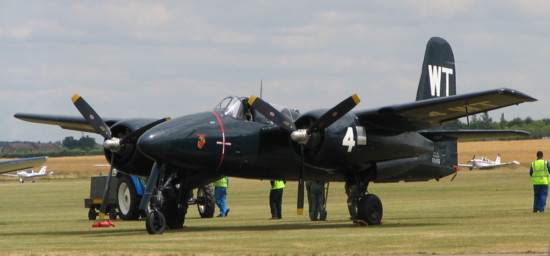
The Grumman F7F Tigercat only just managed to see
service in the last stages of the war, but was extensively used for
some time afterwards.
|
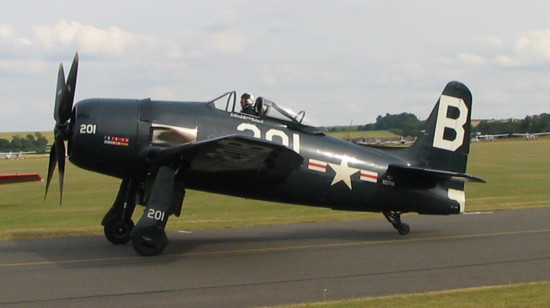
The Grumman F8F Bearcat was too late to serve in
the second world war, but became a potent carrier-borne fighter into
the 1950s until replaced by jets.
|